The short answer: it depends on which plan you're using.
ChatGPT on a free account? Not secure for business. ChatGPT on a Business or Enterprise plan? Much more secure, with encryption, compliance certifications, and data protections built in.
But the full picture is more complicated than that. In 2026, most teams don't just use ChatGPT. They use Claude, Gemini, and other AI models too. And "secure" means something different depending on your company size, your industry, and what data you're putting into these tools.
Let's break it all down.
What "Secure" Actually Means for Business AI
Before comparing plans, it helps to define what security means in this context. When a business asks "Is ChatGPT secure?", they're really asking several questions at once:
Data training: Will OpenAI use our conversations to train its models? If your sales team pastes a client proposal into ChatGPT, could that information end up influencing the model for other users?
Encryption: Is the data encrypted when it's sent to OpenAI's servers and while it's stored there?
Access controls: Can we control who on our team has access? Can we set permissions, require single sign-on (SSO), and manage users centrally?
Compliance: Does ChatGPT meet standards like SOC 2 Type 2, GDPR, and HIPAA? Can our legal and compliance teams sign off on it?
Data retention: How long does OpenAI keep our data? Can we control that?
These are the right questions. Let's see how ChatGPT answers them in 2026.
ChatGPT Security by Plan: Free vs. Business vs. Enterprise
Not all ChatGPT plans are created equal. The security you get varies dramatically based on what you pay for.
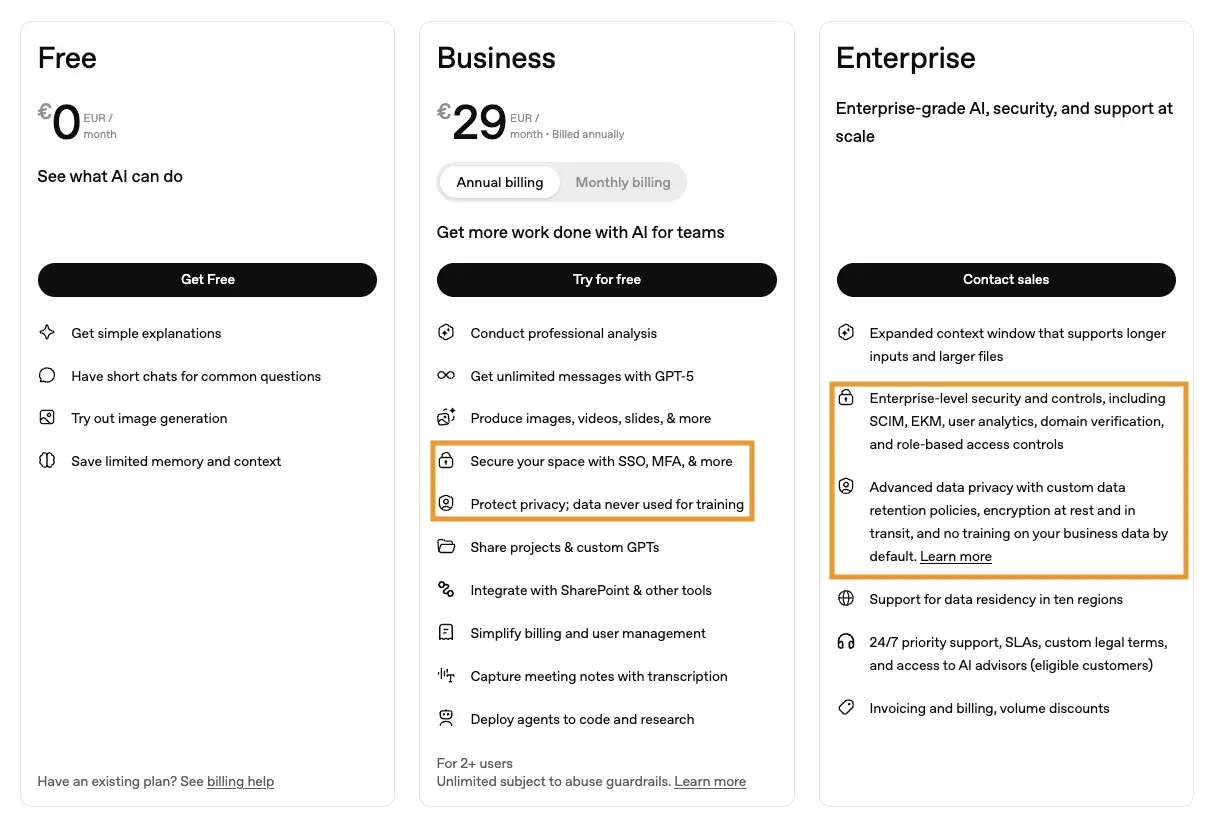
Free and Plus Plans (Not for Business Use)
If your employees are using ChatGPT Free or Plus ($20/month), here's what you need to know:
- OpenAI may use conversations to improve its models by default. Users can opt out, but there's no way to enforce this across a team.
- There are no admin controls. No way to manage users, set permissions, or track usage.
- There is no SSO integration. Each person has their own individual account.
- There is no compliance documentation for these plans. You cannot get SOC 2 reports for free-tier usage.
For personal use, these plans are fine. For business use, especially with sensitive data, they are not appropriate.
ChatGPT Business Plan ($25-30/seat/month)
This is OpenAI's entry point for companies. Formerly called "ChatGPT Team," it was rebranded to ChatGPT Business in August 2025. Here's what you get:
- No model training on your data by default. OpenAI explicitly states that Business plan data is not used to train models.
- Encryption at rest and in transit. AES-256 encryption at rest, TLS 1.2+ in transit.
- SAML SSO and MFA. You can connect your identity provider and require multi-factor authentication.
- Admin controls. Manage users, track usage, and create shared workspaces.
- SOC 2 Type 2 compliance. Covered under OpenAI's SOC 2 report for security and confidentiality.
- GDPR and CCPA support. Data Processing Addendum available.
For many small-to-midsize businesses, this is the minimum viable plan.
ChatGPT Enterprise (Custom Pricing, ~$50-60/seat)
Enterprise adds the features that large organizations need:
- Everything in Business, plus:
- SCIM provisioning for automated user management
- Enterprise Key Management (EKM) so you control your own encryption keys
- Custom data retention policies, including zero-retention options
- Data residency in 10 regions (US, Europe, UK, Japan, Canada, South Korea, Singapore, Australia, India, UAE)
- Role-based access controls with domain verification
- 24/7 priority support with SLAs and custom legal terms
- User analytics to monitor adoption and usage patterns
Enterprise pricing is negotiated per organization, but industry estimates put it at $50-60 per seat per month for most deals. That adds up fast.
What Happens to Your Data in ChatGPT?
This is the question that keeps CISOs up at night. Let's be specific.
On Business and Enterprise plans:
- OpenAI does not train on your inputs or outputs by default.
- Your data is encrypted using AES-256 at rest and TLS 1.2+ in transit.
- OpenAI's infrastructure undergoes regular third-party penetration testing.
- OpenAI has ISO/IEC 27001 certification (received January 2026) and is aligned with CSA STAR.
On Free, Go, and Plus plans:
- OpenAI may use your conversations to train and improve models.
- Users can opt out via settings, but this is on a per-user basis with no central enforcement.
- No compliance certifications apply to these tiers.
The takeaway: if you're discussing anything business-sensitive, you need at least the Business plan. Using a free or personal plan for work is a data risk your company probably doesn't want to take.
The Real Risk: Shadow AI in Your Organization
Here's a problem that security conversations often miss. You can buy ChatGPT Business licenses for your whole team. But what happens when someone on the marketing team prefers Claude for writing? Or when a developer likes Gemini for code review?
In most companies, employees are already using multiple AI tools. Some with company accounts, some with personal ones. This creates what security teams call "shadow AI," where people use tools that haven't been vetted, approved, or secured.
The usual approach is to buy separate business plans for each AI provider:
- ChatGPT Business: $25-30/seat/month
- Claude Team: $20-25/seat/month
- Maybe Gemini Advanced on top of that
For a 50-person company, that's easily $2,500-3,000/month just on AI subscriptions. And you still don't have a single place to manage access, track costs, or enforce policies across all of them.
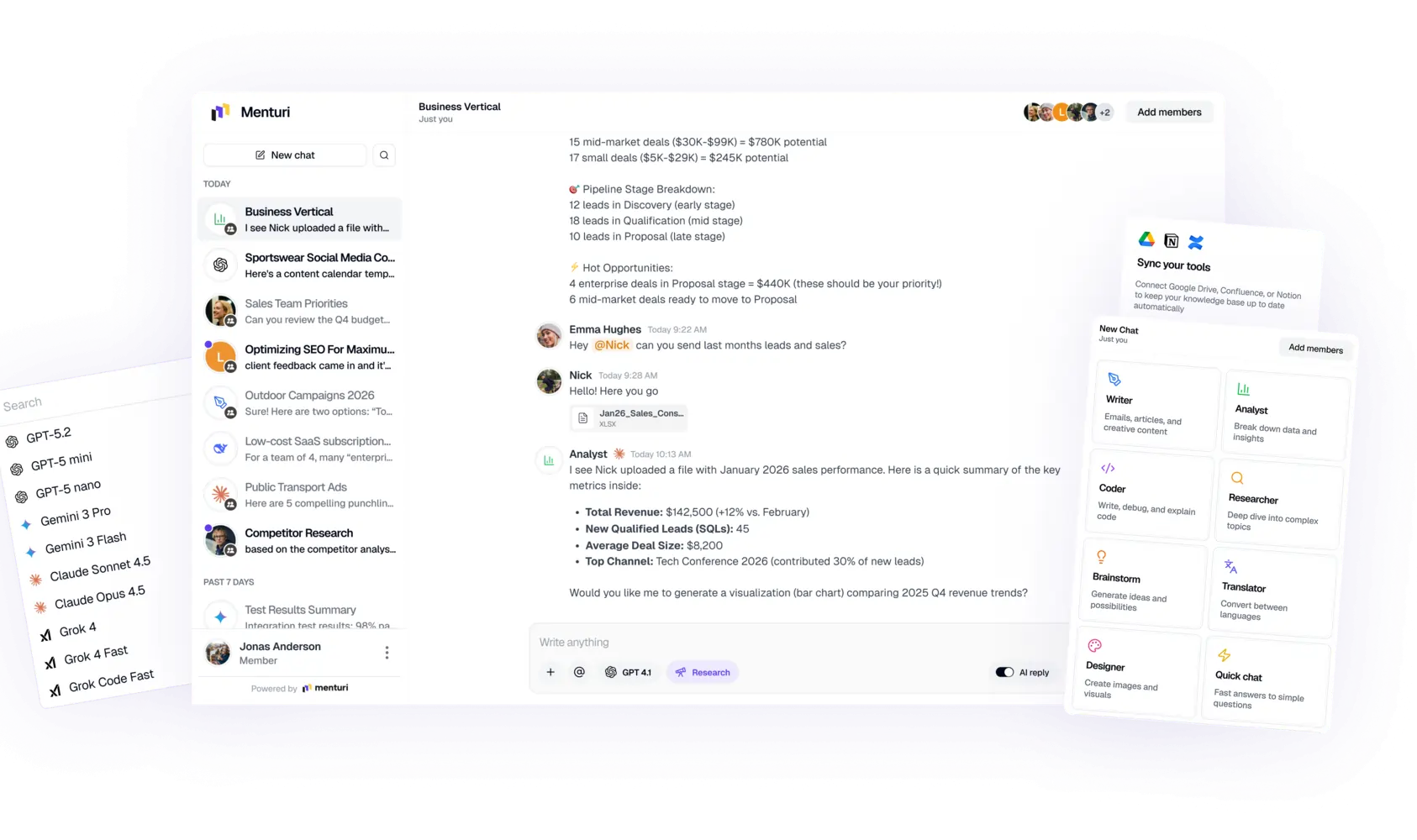
This is the problem that platforms like Menturi solve. Instead of buying three separate AI subscriptions, you give your team one workspace with access to ChatGPT, Claude, Gemini, and other models. Starting at $9.99 per seat per month, it's a fraction of what you'd pay for individual business plans. Your admin gets a single dashboard for user management, cost tracking, and model controls.
From a security perspective, this matters. One platform to secure is easier than three. One set of access controls. One place to monitor usage. One vendor to evaluate.
Security Comparison: ChatGPT vs. Claude vs. Menturi
Since many teams use more than one AI model, here's how the major options compare on security features:
| Security Feature | ChatGPT Business ($25-30/seat) | ChatGPT Enterprise (~$50-60/seat) | Claude Team ($20-25/seat) | Menturi ($9.99-14.99/seat) |
|---|---|---|---|---|
| No training on your data | Yes | Yes | Yes | Yes |
| Encryption (rest + transit) | AES-256 + TLS 1.2+ | AES-256 + TLS 1.2+ + EKM | Yes | Yes (encrypted in transit and at rest) |
| SSO | SAML SSO | SAML SSO + SCIM | SSO + domain capture | SSO (Enterprise plan) |
| SOC 2 Type 2 | Yes | Yes | Yes | Pending (infrastructure on SOC 2 certified partners) |
| Admin controls | Basic | Advanced (RBAC, analytics) | Central admin + domain capture | User management + model controls + cost tracking |
| Cost tracking per user | Basic usage stats | User analytics | Limited | Real-time cost tracking by user, model, and team |
| Multiple AI models | GPT models only | GPT models only | Claude models only | ChatGPT, Claude, Gemini, and more |
| BYOK (Bring Your Own Keys) | No | No | No | Yes (Professional + Enterprise) |
The BYOK (Bring Your Own Keys) option is worth highlighting. With Menturi, you can connect your own API keys from OpenAI, Anthropic, or Google. This means your requests go directly through your existing provider agreements. You keep the data handling terms you've already negotiated. Menturi provides the workspace and management layer without adding another data processor to your stack.
What About Claude Security?
Since Claude by Anthropic is the second most popular AI tool in business, it's worth covering.
Claude's Team plan ($20-25/seat/month, depending on billing) includes:
- No model training on your content by default
- SSO with domain capture
- Central admin controls
- Enterprise search across your organization
Claude Enterprise adds role-based access, SCIM, audit logs, compliance APIs, custom data retention, IP allowlisting, and a HIPAA-ready offering.
The security posture is strong. But if your team uses both ChatGPT and Claude (as many do), you're now managing two separate secure environments. Two admin panels. Two sets of user accounts. Two invoices. Two vendor security reviews.
The Cost of Business AI Security
Security costs money. Here's what it looks like for a 50-person team in 2026:
| Scenario | Monthly Cost | Annual Cost |
|---|---|---|
| ChatGPT Enterprise only (50 seats x ~$55/seat) | $2,750 | $33,000 |
| ChatGPT Business + Claude Team (50 seats each) | $2,250-2,750 | $27,000-33,000 |
| ChatGPT Enterprise + Claude Enterprise | $4,000-5,250+ | $48,000-63,000+ |
| Menturi (50 seats, all models included) | $500-750 | $6,000-9,000 |
That's the difference between spending $63,000+ per year and spending $6,000-9,000. An 85% reduction, with access to the same models.
The question isn't just "Is ChatGPT secure?" It's "Can we afford to make AI secure for everyone on our team?" At $50-60 per seat for enterprise-grade security from a single provider, most companies either limit who gets access or settle for less secure plans.
With Menturi, you get enterprise AI without the enterprise price tag. Every team member gets access to multiple models through a single secure workspace. Admins can control which models are available, track spending in real time, and export usage reports, all from one dashboard.
Business AI Security Checklist
Before you deploy any AI tool for your team, run through this checklist:
1. Data training policy
Confirm that the provider does not train on your business data. Get this in writing, not just in a blog post.
2. Encryption standards
Verify encryption at rest (AES-256) and in transit (TLS 1.2+). If you handle highly sensitive data, look for customer-managed encryption keys.
3. SOC 2 Type 2 report
Ask for it. Read it. A SOC 2 Type 2 report is an independent audit of security and confidentiality controls. If a vendor doesn't have one, that's a red flag.
4. Access controls
You need SSO integration, user provisioning, and the ability to remove access instantly when someone leaves the company. If you're managing AI access through shared passwords or individual accounts, that's a security gap.
5. Data retention policies
Understand how long the provider keeps your data. Can you configure retention periods? Can you delete data on demand?
6. Usage monitoring
Can you see who's using what, and how much? This isn't just about costs. It's about knowing whether sensitive data is flowing through AI tools you haven't approved.
7. Vendor consolidation
Every additional AI vendor is another attack surface, another security review, another set of terms to negotiate. Fewer vendors means less risk. This is one reason platforms like Menturi that consolidate multiple models into one workspace are worth considering.
Pricing Comparison: ChatGPT, Claude, and Menturi Plans
Here's a full breakdown of what each plan costs and what security features you get:
| Plan | Price | Data Training Excluded | SSO | SOC 2 | Admin Controls |
|---|---|---|---|---|---|
| ChatGPT Free | $0 | No (opt-out per user) | No | No | No |
| ChatGPT Plus | $20/mo | No (opt-out per user) | No | No | No |
| ChatGPT Business | $25-30/seat/mo | Yes | SAML SSO | Yes | Basic |
| ChatGPT Enterprise | ~$50-60/seat/mo | Yes | SAML SSO + SCIM | Yes | Advanced |
| Claude Pro | $17-20/mo | No (opt-out per user) | No | No | No |
| Claude Team | $20-25/seat/mo | Yes | SSO + domain capture | Yes | Central admin |
| Menturi Standard | $9.99/seat/mo | Yes | Enterprise plan | Pending | Yes (user + model + cost) |
| Menturi Professional | $14.99/seat/mo | Yes | Enterprise plan | Pending | Yes (user + model + cost + BYOK + Knowledge Base) |
Frequently Asked Questions
Is ChatGPT safe to use for business?
Yes, but only on the right plan. ChatGPT Business ($25-30/seat/month) and ChatGPT Enterprise (~$50-60/seat/month) include data training exclusion, encryption, SSO, and SOC 2 compliance. Free and Plus plans do not offer these protections and should not be used for sensitive business data.
Does OpenAI train on business data?
Not on Business or Enterprise plans. OpenAI explicitly states that it does not use data from ChatGPT Business, Enterprise, Edu, or API platform to train its models by default. On Free and Plus plans, conversations may be used for training unless the user opts out individually.
What compliance certifications does ChatGPT have?
OpenAI's ChatGPT Business and Enterprise products have SOC 2 Type 2 certification (covering security, availability, confidentiality, and privacy), ISO/IEC 27001 certification (received January 2026), and CSA STAR alignment. They also support GDPR and CCPA compliance with a Data Processing Addendum.
Is Claude more secure than ChatGPT for business?
Both are comparable. Claude Team and Enterprise plans offer similar protections: no model training on your data, SSO, admin controls, and SOC 2 compliance. Claude Enterprise also offers audit logs, SCIM, and a HIPAA-ready option. The choice between them is more about model capability than security.
Can I use my own API keys with a business AI platform?
Yes. Platforms like Menturi let you bring your own API keys from OpenAI, Anthropic, Google, and other providers. This means your data flows through your existing provider agreements, and Menturi acts as the workspace and management layer rather than an additional data processor.
What's the best way to give my team access to multiple AI models?
The most practical approach is a unified platform that supports multiple models through a single workspace. Menturi does this, giving your team access to ChatGPT, Claude, Gemini, and more for $9.99-14.99 per seat per month. Instead of managing separate subscriptions, security reviews, and admin panels for each AI provider, you handle everything in one place. Admins can control which models are available, set spending limits, and track usage across the entire team.
How much does secure business AI actually cost?
It depends on your approach. ChatGPT Enterprise alone runs about $50-60 per seat per month ($33,000/year for 50 people). Add Claude Enterprise and you're looking at $48,000-63,000+ per year. With Menturi, a 50-person team pays $6,000-9,000 per year and gets access to all the same models through a single secure workspace. That's up to 85% less.
Conclusion: Secure AI Doesn't Have to Break the Budget
ChatGPT is secure for business, but only if you pay for the right plan. Free and personal accounts are not appropriate for company use. ChatGPT Business and Enterprise plans provide solid security features: encryption, data training exclusion, SSO, and SOC 2 compliance.
But here's the reality of 2026: your team doesn't just want ChatGPT. They want Claude for writing. GPT-5 for analysis. Gemini for research. And buying enterprise licenses from every provider gets expensive fast.
For a 50-person team, separate enterprise subscriptions can cost $63,000 or more per year. With Menturi, the same team gets access to all those models for $6,000-9,000 per year. That's enterprise AI without the enterprise price tag.
If you're evaluating AI security for your business, start with the basics. Make sure no one is using free-tier accounts for work. Get proper admin controls in place. And consider whether a unified platform makes more sense than juggling multiple provider subscriptions.
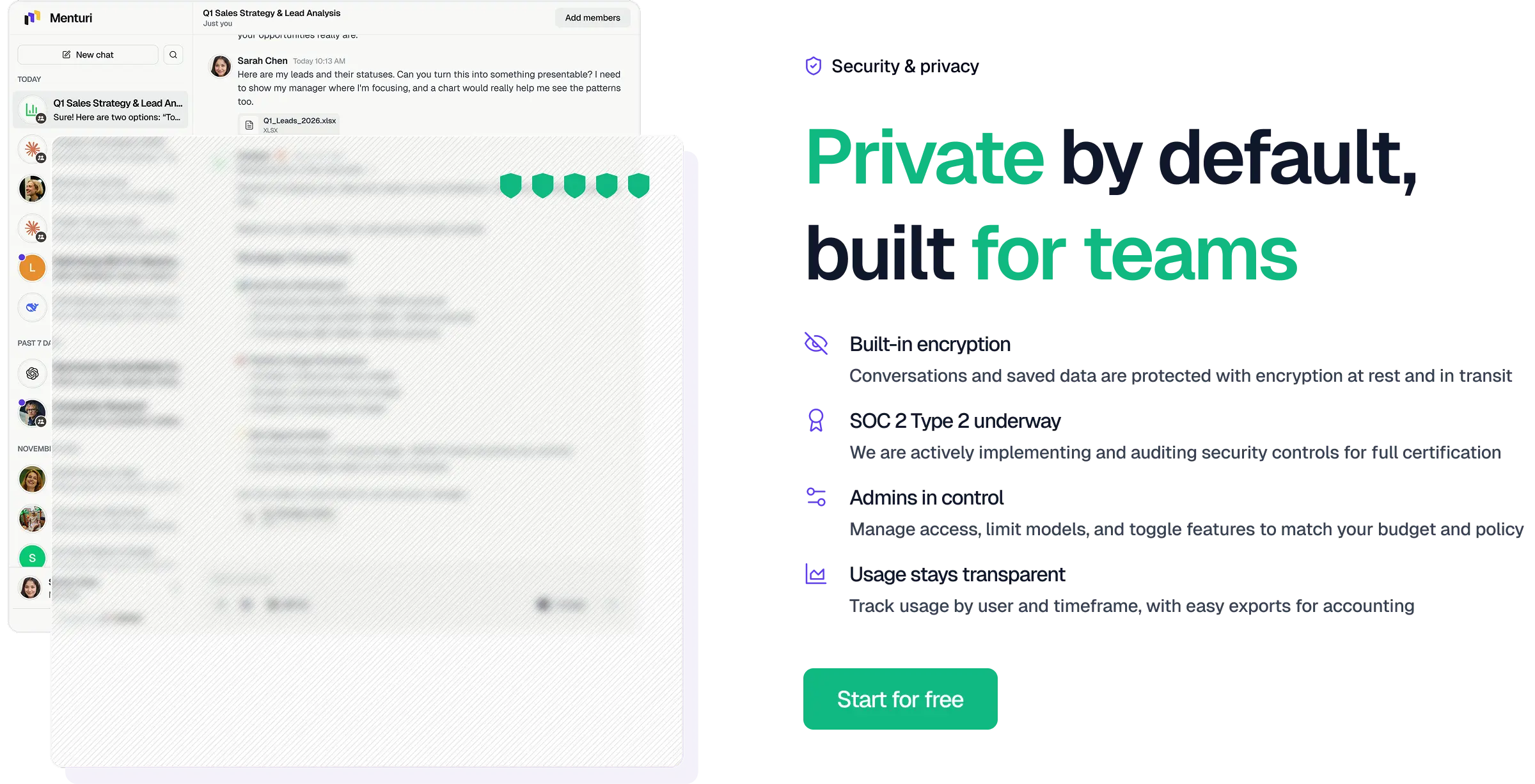
Start a workspace, invite your team, and see how your team can work with ChatGPT, Claude, and Gemini in one secure workspace.